
 Latviešu
 English
 Русский
Quick catalogue guide
Who the AllCredits catalogue is for
AllCredits is a catalogue dedicated entirely to lending. It is useful for anyone planning to take out a loan or wanting to understand how lending works. The catalogue brings together lenders’ offers with their terms, interest rates and examples of loan costs, as well as articles about loan types, interest and credit history.
The catalogue is free to use, with no registration and no personal data required. We are not affiliated with any financial company. Links to lenders in the catalogue are affiliate links: if you take out a loan through such a link, we may receive a commission. This does not affect the cost of your loan in any way. Learn more on our About us page.
Borrower requirements
Requirements vary between lenders, but the most common ones are:
- You must be of legal age. The minimum and maximum age differ between lenders and are shown for each company in the catalogue.
- You must be a citizen of the country where you are applying for a loan or hold a residence permit there. Some lenders also require you to have lived in the country for a certain period.
- You need a bank account in that country: most often your identity is confirmed by logging in to your online bank.
- You need a mobile phone and an email address.
- Some lenders require an electronic signature to sign the contract remotely.
- You need a regular income.
- You should not be on a debtors’ list, although some lenders accept existing debts.
- Most importantly, you should be sure that you really need the loan and understand that it must be repaid together with all costs set out in the contract.
Can I get a loan in another country?
As a rule, loans are issued to residents of the country where the lender operates. If you are a citizen of one country and want a loan in another, you usually need a residence permit and a bank account there, and sometimes to have lived there for a certain period — for example, at least one year. Some lenders issue loans to residents of neighbouring countries who officially work and receive their salary on their territory, but this is the exception rather than the rule. Large lenders often operate in several European countries, but you need to apply through their branch in your own country.
Beware of ads promising “a loan for anyone in any country”. Such ads, especially on social media, are most often placed by scammers. Genuine lenders never ask for money before issuing a loan — no “insurance”, “processing fee” or “verification charge”. If you are asked to pay upfront, it is a scam. Before applying, check that the lender holds a licence: every EU country has a supervisory authority that publishes a list of licensed lenders (in Latvia, this is the Consumer Rights Protection Centre, PTAC).
How to choose a lender
Choose the country where you plan to take out a loan — on the home page or in the site menu. On the country page you will see all loan offers collected in the catalogue. Fast loans come first, followed by consumer loans, business loans, long-term loans and car loans. Not every loan type is available in every country — this means there are currently no such offers there.
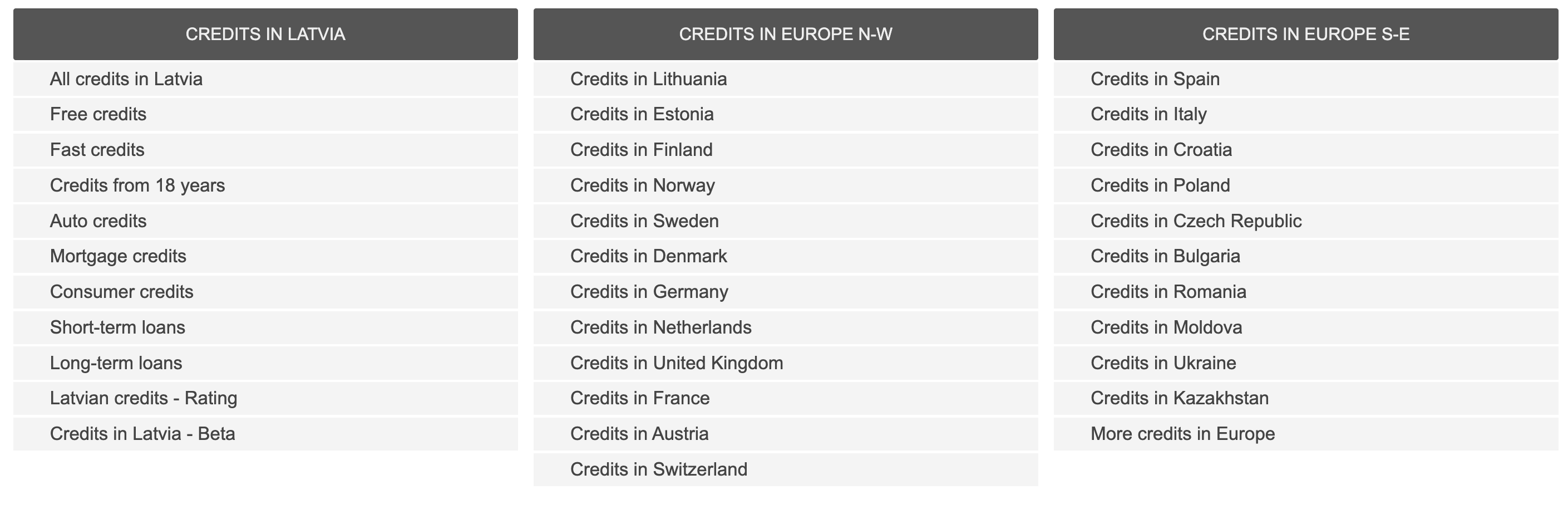
Credits in Latvia | Credits in Lithuania | Credits in Estonia | Credits in Sweden | Credits in Finland | Credits in Germany | Credits in Norway | Credits in Denmark | Credits in Netherlands | Credits in Spain
Decide in advance what type of loan you need, how much you want to borrow and for how long. For each company, the catalogue shows the minimum and maximum loan amount and term. Each card has a cross in its top right corner: click it to hide companies that clearly don’t suit you.
The order of the cards depends on the country. For Latvia, Lithuania and Estonia we compile a lender rating based on their terms, reputation and customer reviews. In other countries, the cards are not ranked: better-known lenders are usually placed higher. Either way, don’t rely only on a company’s position in the list — compare the terms.
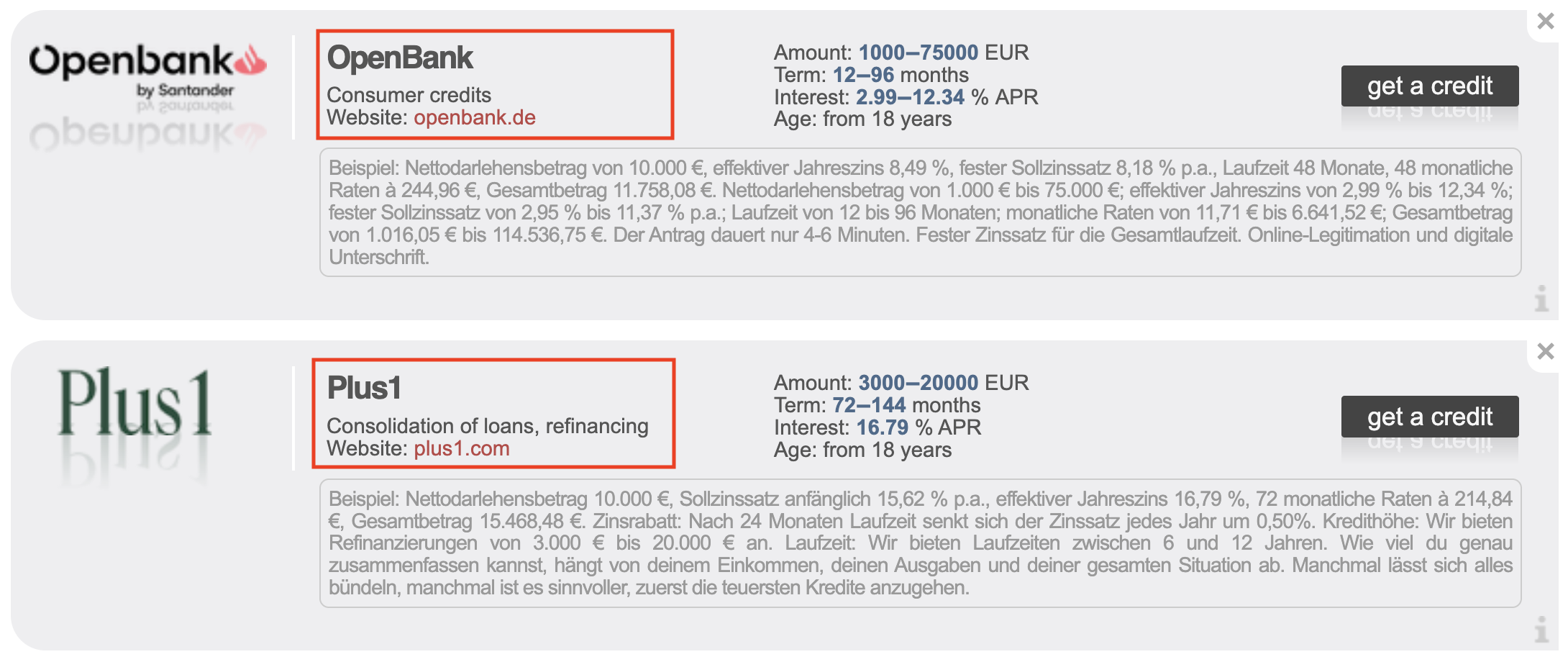
Compare the remaining offers. The key figure for comparison is the annual percentage rate (APR): it includes not only interest but also fees, so it shows the real cost of the loan. Also look at the total amount to repay, late payment penalties and whether early repayment is possible.
How to apply for a loan
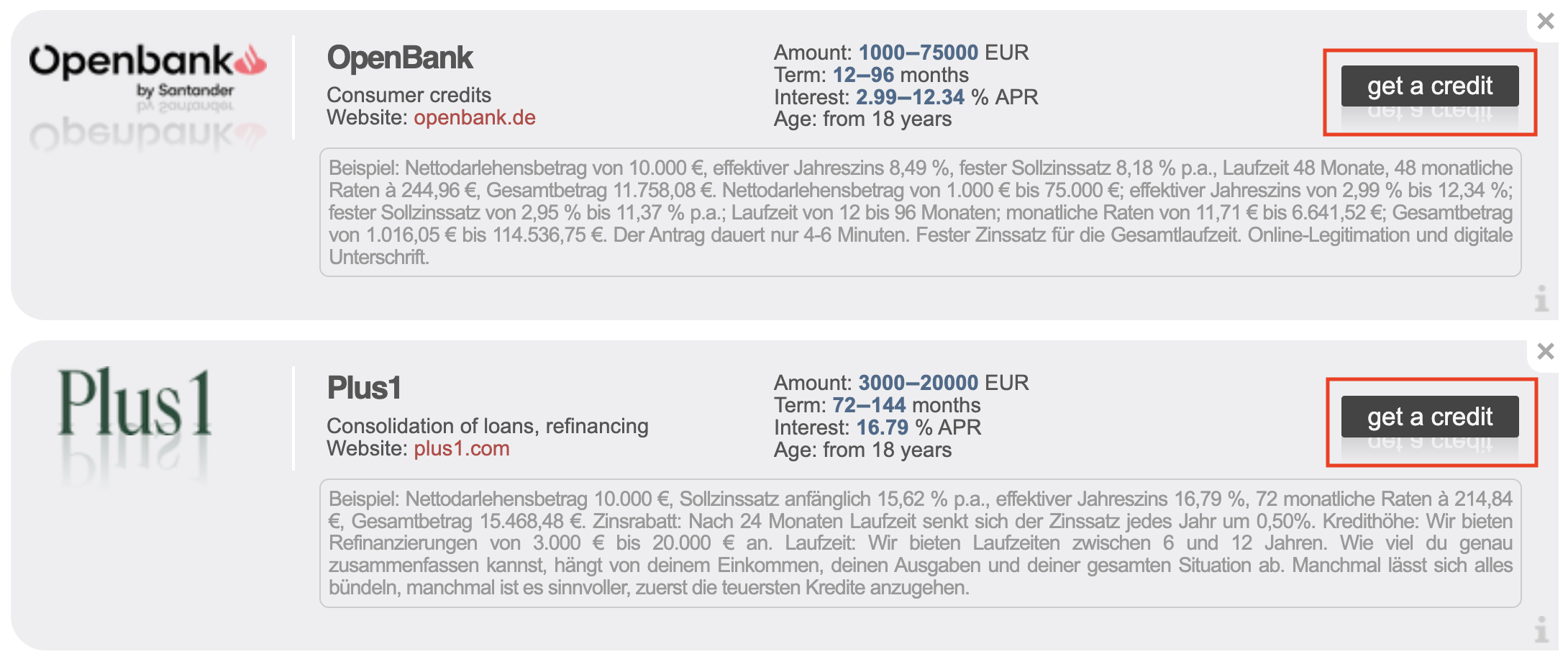
Once you have one or more suitable companies left, click the “apply for a credit” button on the card — you will be taken to the lender’s website. There you fill in an application: the amount, the term, sometimes the purpose of the loan and other details. Submitting an application does not oblige you to take the loan: you will receive an offer and can decline it.
Don’t submit many applications at once. Lenders check every application against credit databases, and in some countries (for example, Sweden and Finland) these checks are recorded and can harm your credit history. It is better to compare terms in the catalogue first and apply to the one or two companies that suit you best.
Questions, comments and reviews
We are grateful to visitors who leave reviews, comment on lenders and ask questions. At the bottom of almost every page there is a comment form where you can publish your review or opinion. If you have questions or suggestions about AllCredits, write to us — all contact details are on the Contact us page.